
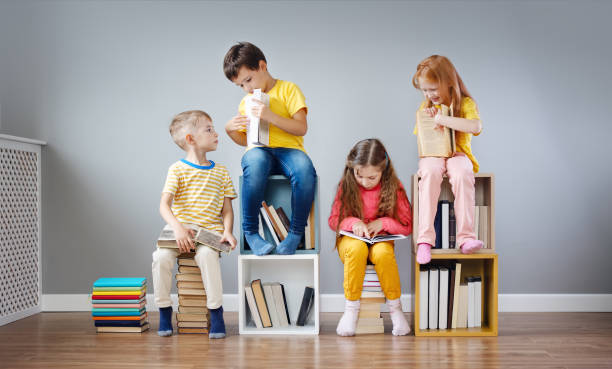

Simple tales with vibrant graphics, talking animals, and creative adventures are often the first things that spring to mind when we think of children’s books. Many adults see them as just providing children with enjoyment, a means of stimulating their developing brains, or a means of preparing them for reading more seriously in the future. However, most people are unaware of the true power of children’s literature. They have the power to mold a person’s character, inspire creativity, affect their values, and create a long-lasting impression on their outlook on life. The tales we read as kids silently influence our thoughts, emotions, and reactions to the world around us in ways we can’t always express.
The capacity of children’s books to convey difficult concepts in easily understood ways is one of their most amazing qualities. These stories tackle topics like compassion, bravery, friendship, empathy, and perseverance via narratives that seem to be simple. Even if a youngster isn’t yet able to comprehend moral quandaries or the subtleties of human conduct, a well-written children’s book may help them grasp such concepts. For example, without ever coming off as preachy, a book about a lonely animal making friends promotes the value of acceptance and inclusion. These kinds of stories sow the seeds of knowledge that eventually sprout, fostering in young readers a strong sense of morality and emotional intelligence.
Additionally, children’s books have a special ability to pique readers’ imaginations. Children live in a world where anything seems imaginable, but adults are often constrained by reason and pragmatism. Children are inspired to fantasize beyond their immediate surroundings by books that depict fantastical animals, distant places, or talking objects. They foster creativity by demonstrating that tales may take on any form and that the possibilities of the human imagination are endless. The development of cognitive abilities and problem-solving abilities depends on this creative activity. Children learn to think critically and come up with answers that go beyond the apparent when they imagine a world that is different from their own.
Additionally, children’s books foster the development of language and communication abilities in a fun and organic manner. Children are introduced to the beauty of words and narrative via the simple but beautiful language of picture books and the rhythmic flow of nursery rhymes. Children’s vocabulary, understanding, and listening skills are enhanced when books are read aloud to them or when they are allowed to read independently. Additionally, it forges a link between the storyteller and the audience, transforming reading into a joyful and intimate experience. The kid will get academic and personal benefits for years to come from these early language experiences, which also provide the groundwork for literacy and a lifetime love of reading.
Children’s books are much more potent since they may affirm and mirror the emotions and experiences of young readers. Uncertainties and feelings that are hard to describe might be common in childhood. Children find a safe haven in books where they may relate to characters that go through similar struggles, pleasures, and concerns. While a book about overcoming failure might encourage resilience, a narrative about a youngster attending school for the first time can reduce anxiety. Children gain confidence and self-awareness by learning via tales that they are not alone in their emotions. For young brains, this emotional connection with reading may be very reassuring and therapeutic.
Children’s books also have a significant impact on fostering diversity and cultural knowledge. Children are exposed to a wide range of individuals, cultures, and lifestyles via books that take them beyond their local surroundings. Children learn to value variety and accept differences when they read about youngsters from other countries or families that look different from their own. Children who may not often see themselves represented in the media are also given representation in inclusive children’s books, which validates their identities and gives them a sense of visibility and worth. The foundation for empathy, tolerance, and a more inclusive outlook in adulthood is laid by this early exposure to variety.
Children’s literature has enormous generational influence as well. A common cultural memory that unites people across time is created by the tales we hear as children, many of which are handed down via families. Consider the timeless appeal of beloved tales like Charlotte’s Web, Winnie the Pooh, and The Little Prince. These works, which provide timeless wisdom that appeals to readers of all ages, are still read and treasured decades after they were first published. These cherished books are often passed down from parents and grandparents to their kids, fostering a feeling of continuity and custom. Children’s books preserve significant values for future generations and improve family ties via this sharing act.
Children’s books have the power to inspire change and quietly affect societal views in addition to fostering personal development. Numerous novels address significant topics like social justice, environmental preservation, and animal compassion in a style that is simple enough for young readers to comprehend. These tales inspire children to take tiny actions to improve their environment and to care about the world in which they live. While a narrative about confronting bullies may teach bravery and integrity, a book on recycling can teach eco-friendly behaviors. Children’s books may foster socially conscious people who go on to make valuable contributions to society by fostering these values at a young age.
Even as adults, we often look back to children’s literature for solace and insight. These tales have a certain simplicity and honesty that appeals to our inner kid and serves as a reminder of the fundamental principles that we sometimes overlook in the midst of adult life. A well-written children’s book often has layers of significance that become apparent at various points in the reader’s life. As a youngster, what could have appeared like a straightforward story of adventure might turn out to be a deep meditation on love, grief, or the human condition. Children’s novels so transcend age boundaries and provide something worthwhile to all readers.
Children’s books continue to play a crucial role in the digital era, as devices take up much of a child’s attention. Books provide a more profound, immersive experience that engages the intellect as opposed to passively ingesting material, even while apps, films, and internet games may amuse. Reading calls for concentration, creativity, and introspection—skills that are crucial in a world full with distractions. Furthermore, a human connection that digital media cannot duplicate is formed when people share a real book by flipping the pages, appreciating the images, and talking about the plot.
It’s also important to remember that children’s books often serve as the first exposure to storytelling, which is an essential aspect of human civilization. People have traditionally used stories to communicate knowledge, preserve history, and make sense of the world. Children who are exposed to tales at a young age join this greater human legacy. They discover that they may use language to connect with others and express themselves by transforming their own experiences into tales. Their capacity to comprehend and sympathize with other viewpoints is shaped by this narrative sensibility in addition to their communication abilities.
The capacity of children’s books to foster a lifelong love of reading is another aspect of their influence. Early reading enjoyment increases a child’s likelihood of continuing to explore books as they become older. This behavior opens the door to a wealth of information, creativity, and personal development. Reading improves life in many ways, from introducing fresh perspectives and ways of thinking about the world to delivering pleasure and leisure. It is not only about academic performance. Children are given a gift that will last a lifetime when their love of literature is fostered at a young age.
At the end of the day, children’s books are much more than just entertaining stories. They are strong instruments that develop hearts, mold brains, and create connections between the actual world and the imagination. They open doors to new worlds, impart knowledge without lecturing, and sow the seeds of curiosity and empathy that blossom into qualities that last a lifetime. The kind of grownups that children will grow up to be may be influenced by the tales they read today. They serve as a reminder that deep lessons that last a lifetime may be discovered in even the tiniest book with the most basic language.
The next time you see a youngster absorbed in a picture book or a bedtime tale, keep in mind that it’s a life-changing event rather than just a hobby. It is possible that those pages are influencing their worldview, beliefs, and aspirations in ways that will last a lifetime. Additionally, reading children’s books again as an adult serves as a lovely reminder of the everlasting wisdom found in simplicity. Ultimately, children’s books have far more power than we realize; one tale at a time, they have the capacity to alter lives, touch hearts, and build a better future.