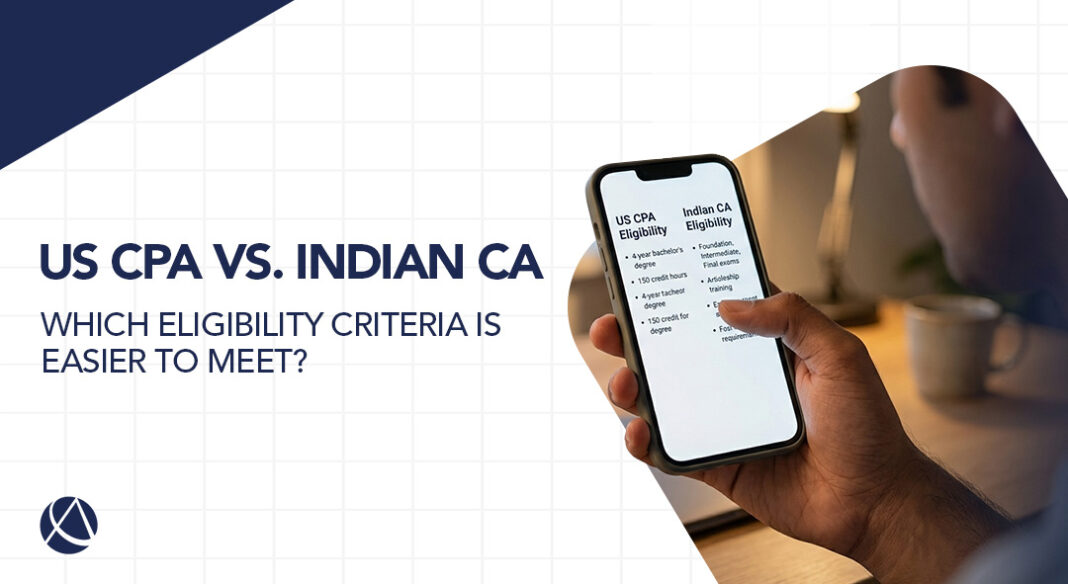

For commerce and finance students in India, the real question isn’t just which qualification is better – it’s which one you can start sooner and complete faster.
Every year, thousands of commerce students face a fork in the road: pursue the US CPA (Certified Public Accountant) or commit to the Indian CA (Chartered Accountant). Both are prestigious. Both open powerful doors. But when it comes to getting started – the eligibility, the structure, the time investment – the paths look very different.
Before you decide, it helps to understand not just which is “better,” but which one you’re actually positioned to begin right now.
“The easier path isn’t always the shorter one – it’s the one that aligns with where you already are.”
Understanding the Two Qualifications
The US CPA is governed by US State Boards of Accountancy and is globally recognized, especially within MNCs and Big 4 firms. It covers accounting, auditing, taxation, and business concepts – and importantly, it is entirely exam-based, with no mandatory articleship.
The Indian CA is governed by ICAI and remains one of India’s most respected professional credentials. But it involves multiple exam levels, a structured progression, and a mandatory 3-year articleship – making it a longer, more intensive commitment.
| Parameter | CA (India) | CPA (US) |
| Governing Body | Institute of Chartered Accountants of India (ICAI) | US State Board of Accounting |
| Minimum Qualification | Can start after Class 12 (Foundation route) | Requires a bachelor’s degree (B.Com / B.Com (Hons.) recommended) |
| Graduation Requirement | Not mandatory to begin | Mandatory for CPA exam eligibility |
| Percentage Criteria | Direct entry requires 55% (commerce) / 60% (non-commerce) | No strict percentage cut-off |
| Flexibility in Eligibility | Fixed structure defined by ICAI | Flexible across US State Board of Accounting requirements |
| Entry Routes | Foundation route (after Class 12) or Direct Entry (after graduation) | Single route based on credit hours and degree |
| Articleship / Training (for eligibility to sit exams) | Not required for Foundation, but mandatory later (3 years) | No mandatory training required to sit for CPA Exam |
| Subjects Requirement | No subject-specific eligibility criteria | Requires 24 credit hours in accounting-related subjects |
| Eligibility for Commerce Graduates | Eligible via direct entry (if percentage criteria met) | Most B.Com graduates close to CPA exam eligibility |
| Eligibility for CA Inter Students | Already in CA pathway | CA Inter students are eligible for CPA Exam in many cases |
| Global Recognition Impact on Eligibility | India-focused qualification | Globally recognized eligibility pathway |
| Application Process | Register with ICAI | Register with AICPA |
CA Vs. CPA Academic requirements
Breaking down eligibility, criterion by criterion, the CPA requires a bachelor’s degree – but no strict percentage cut-off. It uses a flexible credit-hour system, and most Indian B.Com graduates already have approximately 90 credits. If you’re short, bridge courses can fill the gap without restarting your education.
The CA, by contrast, allows entry right after Class 12 through the Foundation route. However, direct entry for graduates requires 55% for commerce graduates or 60% for non-commerce graduates – a bar that some may not meet.
CA Academic requirements
The Indian CA pathway is structured to allow early entry, even before graduation.
- Students can begin right after Class 12 through the Foundation route
- Graduates can skip Foundation via the Direct Entry route
- However, Direct Entry requires:
- 55% for commerce graduates
- 60% for non-commerce graduates
Once you enter the CA pathway, the structure is fixed, with limited flexibility to adapt or bypass stages.
CPA Academic requirements
The CPA pathway is designed for graduates and working professionals, focusing on academic exposure rather than marks.
- Requires a bachelor’s degree (B.Com or equivalent recommended)
- No strict percentage cut-off
- Based on a credit-hour system
CPA Exam eligibility (120 credit hours)
- Minimum 120 credit hours required
- Typically includes:
- Bachelor’s degree
- 24 credit hours in accounting-related subjects
Most Indian B.Com graduates already have 90-120 credits, making them close to eligibility.
CPA License eligibility (150 credit hours)
- 150 total credit hours required
- 1–2 years of relevant work experience
- Ethics exam (depending on the US State Board of Accounting)
The credit hour advantage
This is where CPA stands out.
Instead of rejecting candidates based on marks, CPA allows you to bridge the gap:
- If you lack credits, you can take bridge courses
- If you lack specific subjects, you can complete them separately
- You don’t need to restart your degree
For example:
- B.Com (3 years) = 90 credits → needs a bridge course
- B.Com + M.Com / MBA → typically meets 150 credits
- CA Inter / similar qualifications → often helps reach 120+ credits
Flexibility vs rigidity
- CA eligibility is fixed and percentage-driven. In CA, if you don’t meet the percentage, your options are limited
- CPA eligibility is modular and adjustable. In CPA, if you fall short, you can actively fix your eligibility.
Entry Flexibility
CPA’s state board system gives candidates a real choice – different boards have slightly different requirements, and credit gaps can be addressed. The CA structure, defined entirely by ICAI, leaves little room to adapt once you’ve entered. CPA wins on flexibility.
Time to Become Eligible
If you already hold a degree, you’re likely close to CPA eligibility and can begin preparation almost immediately. The CA path, unless you’re on the direct-entry route, requires clearing the Foundation exam before you can move forward.
CPA allows faster entry for graduates.
Mandatory training
This is where the gap widens most noticeably. CPA requires no mandatory articleship to sit for exams – work experience is needed only for the license, not for the examination. CA mandates a full 3-year articleship that cannot be shortened or skipped.
CPA requires significantly less mandatory training
The Credit System Advantage
One of the most underappreciated aspects of CPA eligibility is its credit-hour model. Instead of rigid academic percentages, it evaluates total credit hours and subject relevance. If you don’t meet 150 credits, you can take additional courses or enrol in a bridge program – without restarting your academic journey. This kind of flexibility simply doesn’t exist within the CA framework.
What Students Often Overlook
Many students assume CA is easier because it starts early and doesn’t require a degree. What they underestimate is the time required to clear all three levels, the intensity of the articleship, and the historically low pass rates at each stage.
On the other hand, students may hesitate over CPA because the international process looks unfamiliar. In reality, most Indian graduates are already close to meeting eligibility – and once they understand the credit system, the path is more predictable than it appears. With CA, your early years are largely committed to articleship, which can delay full-time earning potential, whereas you can prepare for the US CPA with 12 to 18 months as a working professional and unlock global opportunities.
Which is Right For You?
Choose CPA if you…
- Already hold a B.Com, BBA, or finance degree
- Want global career opportunities
- Prefer a flexible, exam-focused path
- Want to avoid long mandatory training
Choose CA if you…
- Are starting right after Class 12
- Want to build a career primarily in India
- Prefer structured, traditional progression
- Are prepared for a long-term commitment
The Bottom Line
If we’re talking purely about eligibility criteria, the US CPA is generally easier to meet for graduates – it’s flexible, faster to enter, and doesn’t demand years of mandatory training before you can sit for exams. The Indian CA, while accessible right out of school, becomes progressively more demanding as you advance through its stages.
In simple terms: CPA offers a flexible, faster entry. CA offers an early start with a more rigid, long-term structure.
Neither is inherently “easier” as a whole – but understanding where you stand today, and where you want to go, will make the right choice clear.
Thinking about starting your CPA or CA journey?
Edumont Classes offers expert-led preparation for both qualifications. Speak to a counsellor to find the path that fits your profile.